DAMN / Governance
How far the control actually goes.
The failure modes it covers, the mechanism underneath, and the exact point where each control stops.
Failure modes
Real failures need a real system.
AI agents move fast. Mistakes, drift and attacks move just as fast.
Leaked keys & access
Keys resolve server-side and access is enforced there, never on the agent.
Destructive actions
Payments, deletions and production writes are gated: refused, or held for a human.
Runaway spend
Cap monthly cost per agent, team or workspace. Cross the cap and the key stops working.
Audit gaps
Every action on a tamper-evident, hash-chained trail.
Access drift
EnterpriseEvery agent tied to your identity provider through SSO, SAML and SCIM.
Data exfiltration
EnterpriseOutbound limited to the hosts you allow. Everything else has no route out.
No inventory project
The map draws itself.
Scoping stops being a project and becomes a review.
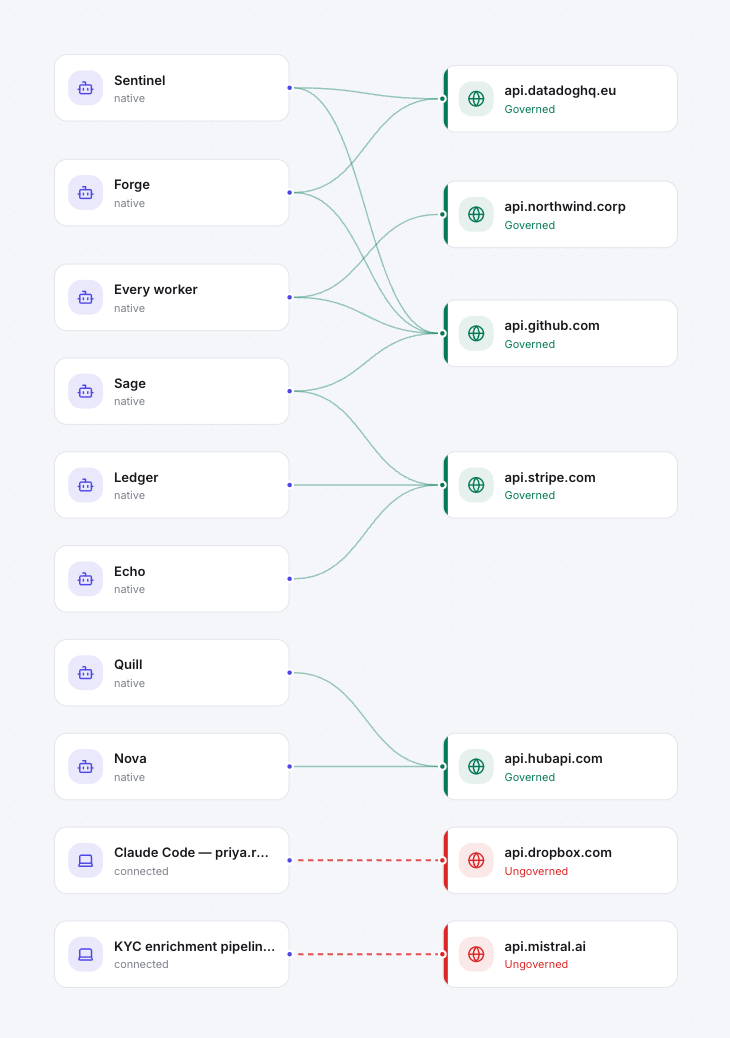
The control layer
One control layer for every agent.
One registry, one identity for each worker, one policy engine, one approval pipeline, one tamper-evident audit trail. Built in-house or connected from outside, every agent answers to the same five.
Built here
Ops agents
Connected
Coding agents
Connected
Vendor agents
One control layer
The mechanism
Hold the keys, not the conversation.
Default reads nothing. An optional tier can inspect, and it runs on your box behind your own certificate authority. Content never reaches us either way. We enable inspection. We never perform it.
The work stays private.
Guardrails
Hard rules, checked first.
And you can fire them on demand to prove they still hold, including with the connection cut.
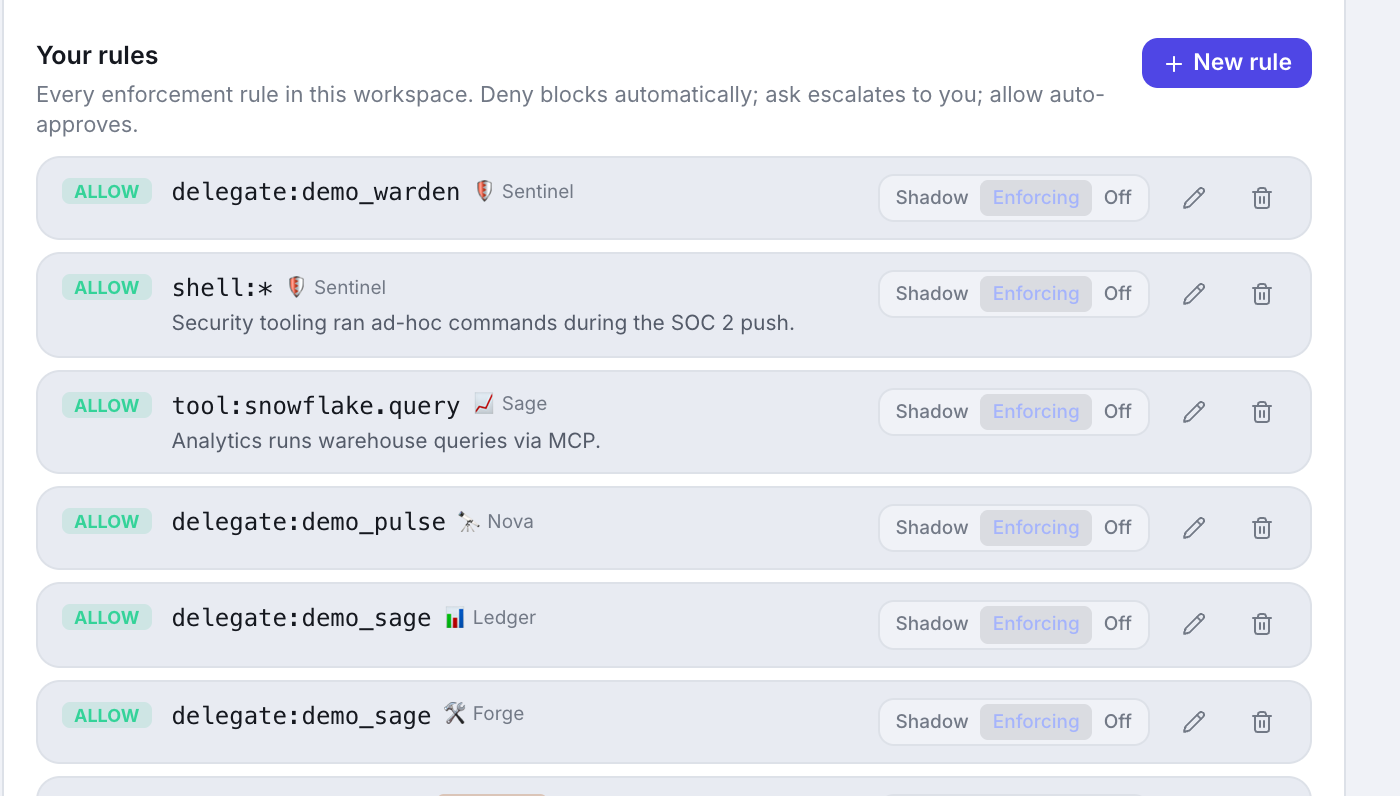
Governance model
Detected, observed, gated, contained.
The product tells you exactly which tier each agent is in. We never blur the line between what we observe and what we enforce.
Detected
The agent exists and has an owner. Not yet reporting, not yet gated. The gap the registry surfaces first.
Observed
Its activity is attributed and recorded, on a trail nobody can rewrite.
Gated
A key, a destination, a file or an action is decided before it is used. Refused, or held for a human.
Contained
The execution environment enforces the boundary. Keys short-lived, outbound limited to hosts you allow.
Contained mode
When the boundary has to be the environment.
Sovereignty
On your servers. Never ours.
Your agents, their permissions, and their audit trail stay inside your boundary. Your machines, your models, your data. Nothing leaves your perimeter.
Outside your control
Your perimeter
Everything runs here. Nothing leaves.
Your agents. Your rules. Your data.
Damn secure.